2015-07-08

Public Displays of Racism & White Privilege

Recently I witnessed possible discrimination happening between two different customers at a restaurant. The person alleging discrimination was Black. What bothered me most was how the hostess apologized to the White couple after she left and then proceeded to apologize to me after I questioned her about what had happened. Our waitress did the same. This woman couldn’t defend herself now that she had left. I asked our server and the hostess if she felt that she was being discriminated against and they confirmed this but denied that any discrimination happened, “Oh that’s not what was going on. I don’t know why she thought that.”

Here’s some truth for you: it probably was happening. I saw that White couple, I saw how they were looking at her. Both the server and the hostess were White. The complaining customer was Black. We’re in Portland It’s quite damn possible that she was being discriminated against.

About a month later I went back to this venue and again noticed that with the same hostess, there were two different couples with Black members and they had been sat in the back, away from the windows or by the kitchen entrance. There were many other seating options closer to other customers that were noticeably unoccupied. This really made me consider the incident I witnessed before and whether or not I was going to patronize this establishment. I once was a friend with a person who worked for that restaurant and he had some decidedly racist and classist things to say when complaining about customers. In this environment I am sadly unsurprised racism could be going down.

The waitress and hostess’ incredulity about what took place is familiar to me. I find that White folks balk at the mention of racism and rush to defend themselves or a situation away from it. I even have friends who will do this. They are quick to try to explain away the person’s actions. My own partner is guilty of it. It’s very frustrating for us to be told that our experience is somehow blind or incorrect.


So what I took away from this, as a Latino, as a person of color, is that I really need White people, (and especially my White friends) to consider that racism does happen to us whether or not they witness or perceive it. That’s one of the “joys” of White privilege; you don’t have to experience racism. So please stow your apologies and explanations.

2015-05-29

Give Us Back The City

Almost two years have passed since I first began writing and documenting the surge in Portland’s creeping gentrification and what the monoculture means for the rest of us. I barely recognize the city anymore. In my last article on gentrification I talked about the gay street I used to hang out on when I first moved here and how different it is. I could write an essay on every neighborhood here with similar content.


Our mainstream media has finally caught up and started writing about gentrification and the current housing crisis. It’s not without drama however, the latest being a Willamette Weekly contributor writing an arrogant op-ed about his apartment complex the Burnside 26 which created a lot of controversy with it’s promo video showing a very White Upper Middle Class heterosexual couple enjoying a leisurely lifestyle. It made a lot of people angry.

Some bullet points about the current issues at hand include us having the lowest vacancy rate in the country (12%), a recent exposé that provided documents showing City Hall officials had hidden high-rise development projects from the public, news that Google will be opening an office downtown and a recent report that Portland is the most gentrified city of the city.

So where does that leave the rest of us?

I’m terrified of being priced out; the signs are already there. The cost of food and transportation continues to rise as rents inflate. Looking at the housing market, homes that cost 300,000 in 2007 are now double that.

The city has changed so much. Along with the prices, the culture has changed. The people have changed. I don’t feel welcome in a city that was a sanctuary for me in my younger years. I am afraid I won’t be able to stay here in the long term.


Gentrification is breaking my heart.
I don’t have answers, I don’t have a solution.
I only have my slow boiling rage.

I’ve engaged in a lot of dialogue recently about gentrification, especially about those who are contributing to it such as tech companies and white collar suburbanites who are flocking to cities like Seattle, San Francisco and Portland. I’m done being civil about it.

So I’m going to be frank.

This is a culture war. It’s a war for the soul of the city. Somewhere along the line Portland got popular and was put on the cultural map. What was weird is now gone and replaced by this monolith of White middle-class monoculture. So I say this to you, the gentrifiers: You are pushing us out! If you want to live in a family-friendly neighborhood, go live in the suburbs!
GO AWAY. Stay out of our communities! We didn’t build this for you.


As Seattle artist John Criscitello said:

“WE CAME HERE TO GET AWAY FROM YOU.”


2015-04-02

THE MYTH OF PROGRESS

Dear White Collar Scum,
Hey, oye, it’s me, the one you want to ignore
Do I make you uncomfortable?

Got that Shania Twain hook stuck in my head
No way man I don’t care about your new condo
Or how walkable it is here

White gurls in top buns
With social work degrees
Insist on stories of how awful homeless people are

“That don’t impress me much…”
This isn’t a game to us
It’s a fucking culture war

“Gay bashings up 12% in the city…”
Don’t bro me if you don’t know me
I really don’t know what to say

When you are murdering our city’s life
Our culture, our art, our breath
It’s a fucking culture war

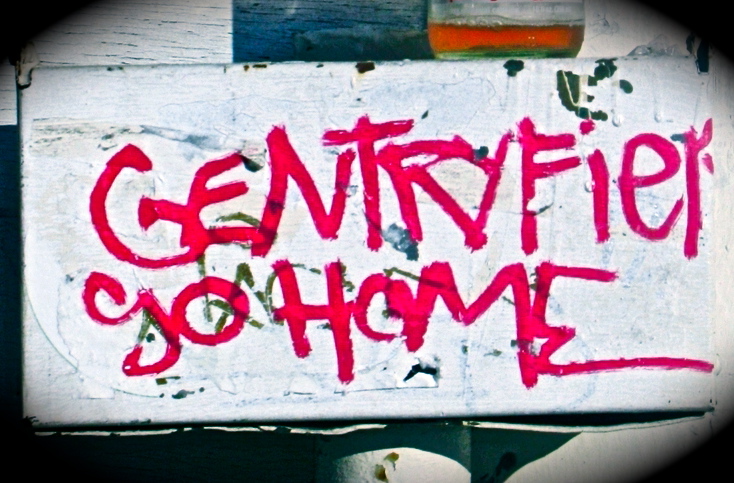
Gentrifiers go home!
I’m not another casualty in the culture war
When giving up is not an option

Because we haven’t tasted the rainbow
Safe spaces for whom?
No, no están bienvenidos para acá.

Goodbye woo girls and dudebros
Don’t fucking look at me
I didn’t do this for you

Brown, queer, disabled, working classes
Hordes of beloved community
Where do we go?

Fuck you Dan Savage,
For telling us
That our artistic pain is for nought

We want this
Scheduled departure to white flight
Fuck your family values

No, that don’t impress me much…

2015-03-27

Life Under Portlandia


I’ve struggled over the last few weeks with what to write in this essay, it’s really been haunting me. I feel embattled by culture and by my own feelings. I moved here when I was still a teenager. Portland was exciting, new and even a bit gritty. Things here were more rockabilly and less twee. I suppose it must have been before the era of the IPA and brunch. To me it is not a surprise that a recent national study found that Portland was the most gentrified city of the century.


During my first three years I saw our rent increase twice, which was not ideal but it hadn’t priced me out of the neighborhood. As time wore one though, I witnessed the distinct character of the Portland that I was enthralled by as a teenager and young adult change. I would say that the change has been more drastic than gradual.

In college I learned what gentrification is and I also learned about the historical (and perhaps continued) redlining of certain districts in Portland that systemically disenfranchised the Black community. I would point out the Mississippi, Alberta, Albina, and Irvington neighborhoods as specific and ongoing examples of this gentrification.


What is (perhaps to some) not surprising is that this is now happening to other neighborhoods all around the city, mostly in Southeast but also much of the Downtown area is becoming gentrified. I think gentrification is still a dirty word in Portland, I swear it’s a conversation to clear a room or get looked at like you dropped a couple of f-bombs.

However it seems like now people care about it a little more now (see the somewhat offensive “Le Tour de Gentrification” of last summer) and some recent articles in local and regional papers. Perhaps this is because it’s not just happening to the POC neighborhoods. Portland seems to be full of perennial White guilt and avoidance of race-based discussion. But then, we have “Oh no, not our food carts”.

Anyway, gentrification is happening all over the city to some extent as the city government tries to attract new companies and higher-earning citizens to come invest in Portland. Two examples of neighborhoods being gentrified that are personal to me are the Stark street area downtown and Division Street in Southeast.

The stretch of Stark Street from what is now a McMenamin’s Crystal Palace to Living Room Theatres was the gay street. It was colloquially known as Vaseline Alley or the Pink Triangle. It is still home to the Roxy but also hosted five gay establishments including the bathhouse that the McMenamin’s corporation turned into a hotel/restaurant.  There was also a wonderful goth night at the Fez Ballroom which is also now closed. The last gay bar on the street is Scandals, and there are rumors that it too will be closing its doors soon.

As a queer person, I used to hang out on this street. It felt like home. Sure it was a bit wild and sometimes nasty, but it was familiar and safe. Now I don’t recognize the street of pavement covered in bougie hipster coffee shops, eateries (one of which whose owner has some questionable ethics) and the Ace Hotel. These new places, they’re not built for my communities. They serve the influx of new residents who move from places where these kinds of businesses are an expected norm.

Now to Division Street, which is a growing example of this norm. This stretch of asphalt had been, for a long time, gritty and exciting but not so suburban. I remember walking its lengths many times, past the porn theatre and various dive bars. One of my favorite cafés was on Division. At this point the clientele has changed so much that I do not feel comfortable or welcome in there anymore.


Along with the demographic changes of the neighborhood, developers have lined lower Division with condominium complexes, all with the same boxy style to where it’s difficult to see where one ends and one begins. Parking has become an issue for residents as tourists and others flock to the neighborhood to stand in line for hours at the new Salt & Straw or browse the many pop-up boutiques.

The neighborhood is becoming unaffordable to long-time residents and the new businesses and living quarters that are being built are a harbinger of this.  The rents are ridiculous. Just take a look at the prices of meals at the new restaurants, look at the clothes people are selling or the cars lining the side streets. It’s not a working-class or artistic community area anymore.

Two things happened recently that really galvanized my desire to write this essay. I had a conversation with a colleague of mine who was from Portland. We both used to hang out at the same spots downtown when we were younger.

Talking with her got us both nostalgic and we discussed how all the places we used to frequent were either closed or were now so different that we didn’t recognize them anymore. Some of our old haunts and activities included going to the two underage clubs, smoking cigarettes in the back room of Anna Banana’s, staying up ‘til 2am at Portland Coffee House on Broadway and Alder, dancing to salsa and bachata at Andreas over on Belmont. Sadly, these are all fantasy of distant memory now. A sports pub has replaced Andreas, and Portland Coffee House is now called Public Domain, closing around 9pm and definitively no longer welcome to the previous community of assorted freaks, students, street kids and artistic types.


It is this culture shift that I see in the Red & Black Café closing, the other recent event that has contributed to this essay. While the owners of the café did not specify why they are closing up shop, they did say that business took a nosedive once the New Seasons market and Starbucks opened for business on the street.

The Red & Black café has served many of our alternative communities in Portland for a long time. I know them as a safe space away from bigotry and police violence as well as functioning as type of community center for like-minded citizens. I think what scares me the most about their closing is that to me, it signals a visible shift in the politics of the city.  I perceive Portland as becoming more conservative, a neoliberal kind of conservative to be sure but we’re definitely not as radical as we used to be.

It is because of this shift in both demographics and politics that I fear for the soul and character of this city. Many of us have lived here for so long and are invested in the long-term health of our communities here, but when things change so drastically and it becomes unwelcoming to us, especially for those of us who are minorities, where are we supposed to go? Seattle, Oakland, Austin and other similar areas aren’t much different.

This is why gentrification matters to me, and why I won’t stop criticizing the Portland city commission, the business commission or the mayor’s office. It’s why I involve myself in writing, organizing and trying to fight bad policy that affects our communities. I live here; this town raised me and taught me so much.  

Gentrifiers beware: We want our city back!


2014-05-27

The Intersection of Street Harassment and the Commodification of Our Bodies


I’ve been sitting on this story for a few weeks now; still riding out the wave of the QSOCC conference and all the momentum it has given me. The night after the conference an incident happened to me, and that got me thinking about the commodification of my body. It happens to many of us, especially if we’re queer, fat or POC. I happen to be all three.

The night in question was spent dancing until two in the morning at Berbati’s with my cousins, my bf and other friends. We had a great time. However, after we left the club I was walking down the alley and this White woman started hollering at me, “OH MY GOD I LOVE YOUR HOODIE! I LOVE YOUR HOOPS” and THEN she grabbed at me. I didn’t even react; I kept walking.  It’s become so normalized to me.

The next day however, I started thinking about the incident and how used to that kind of interaction I have become. This woman saw me, a queer fat person (probably not brown because I pass) walking down the street and thought she had a right to touch me. I don’t care if she liked how I dressed, she had NO right to touch me and get into my personal space.

The commodification of our bodies is commonplace in U.S. culture: our fashion, our music, our androgyny, and our bodies. Everyone wants a piece when it’s popular and new. We become nonentities: the fat and sassy gay person, the exotic brown other. bell hooks called this, “eating the other”. We become exploitable by the majority.

This commodification becomes especially salient and dangerous when intersected by street harassment. When people start seeing us as nonentities available for their consumption our identities are erased and we are open to violence. This is a dangerous place to be, walking down the street, as we are navigating White space or heterosexual space.


Fabian Romero said that it is revolutionary to love our queer, fat, immigrant, brown, disabled, non-cisgendered bodies. I believe we should also take this revolution to the streets and push back against the commodification of our bodies. We ought to push back against street harassment. We are not the exotic object! We are PEOPLE. And we deserve our body sovereignty.

2014-03-27

Decolonize Me

I am winding my way through crowded bodies
Rolling my eyes at you: Of course I speak Engleesh

No me llames papi
I'm not some south-of-the-border fantasy

My body lies beyond the sea
África se viene de mis ojos

Past lives, ancient legacies
Hablo en soltura, speaking in tongues

Francés, árabe, hebreo
Aiwa ya habibi, que no me entiendas

No me importa tu idioma
I'm not gonna fuck you

Sorry, I'm circumcised
Y mato a tus fantasias coloniales

2014-01-16

More Fat Musings


So I was browsing Hari Kondabolu’s tumblr account because he has amazing politics and I have a crush on him. I was heartened to find his reblog of a short Salon.com article by Haley Morris-Cafiero documenting her photography project, Wait Watchers, where she turns the lens back on people that stare or give her dirty looks due to her weight. I had seen Morris-Cafiero’s work before and I was excited to share it again on my Facebook feed. I’d shared it before, but I don’t know why this time it just felt important. 
Hours later I noticed a Facebook friend of mine (not especially a friend persay) had shared my link without linking the full exhibition via Morris-Cafiero’s website and had proceeded to curate a conversation with her friends on her Facebook that consisted of breaking down Morris-Cafiero’s work and denying that the artist may experience oppression due to her size. The thing that made me angry the most was that all of these people commenting were thin. They were searching very hard to find other explanations for the subjects’ expressions around Morris-Cafiero. 
This all made me angry and a bit sad, but then I remember that this person who shared the link was the same person who proceeded to tell me and another friend about how horrible it was to be around fat people in the Houston airport, and how funny they looked using the tram because they were too fat to comfortably walk the distance. 
I admit I don’t understand this person very well. What I do understand though is that she does not see the people in the fat bodies. Fat people are an inconvenience to her. Fat people are subjects of jokes and derision. 
What it reiterates for me is that fat people are not worthy of humanity, and because I am fat that includes me. I'm sick of being dehumanized and watching others be dehumanized because our bodies are seen as invalid.


(Please check out Haley Morris-Cafiero's awesome work here)

2013-09-19

Untitled (a poem)


you fucking left me, you left me on the train
i saw your eyes glazing over while that man wrapped his thick fingers around my neck and tried to take my humanity from me.
i watched you look away, i watched you pretend like it wasn’t happening
what the fuck is wrong with you?
i will not be another Kitty Genovese because
there have been far too many of us already

people talk about phoenixes,
but what they don’t really remember is like Mama Butler said, we gotta burn before we can rise and well I have fucking burned so many times I have fire in my blood instead of haemoglobin.

those horrible clawing fingers and those vile words are not perceptions
that is why every slur, ever dirty look is like a dagger in my soul
they are facts in my life, that shit happens
how do you tell someone that you’re sorry?

i gotta rise above,
we, all us Kittys, we are all phoenixes
there is no other choice, no other road
i take my rage and hide my face
i spit truth because i cannot lie
i cannot die

because you left me on the train.
and my life is worth so much more than that


(c) 2013 T.G.

2013-08-07

Community Alert: Hate Crime in Downtown Portland Last Night

On August 6th around 9-10pm a Latina woman was assaulted by a group of White men after she refused to acknowledge their initial harassment of her. They punched her and also threw garbage including beer bottles at her. The crime occurred on Stark and 13th Avenue in downtown Portland, OR. If you can identify any of the people in the photos or have any other information about this crime please contact the Portland police's non-emergency line @ 503-823-3333.


I’ve had some interesting epiphanies this week, as usually happens during this time of year. I am seeing myself in new ways. I forget that despite my strong identification with my roots and my brown-ness, my skin color allows me White passing privilege and most people don’t identify me as POC. Overt racism towards me usually occurs when I “out” myself. The micro-aggressions (and actual aggression) towards me may have more to do with the fact that I don’t wear clothing and accoutrements that are stereotypically consistent with my perceived gender (male) and that this also makes me “visibly” queer.
It’s funny that I have thought more about and agonized over my brown-ness and neglected to consider this other facet of my identity. Maybe it’s because I am more comfortable with my appearance and fashion choices. I need to think about my White-passing privilege more and how that intersects with my more “visible” differences. 
(p.s. masculinity/femininity are social constructs and I will make them into whatever I desire)

2013-06-25

United States of What?

Both of my parents came from working class backgrounds and rose out of their class level. They taught my sister and I the value of hard work, community involvement but also to be critical of the status quo.

It is through those lenses that I developed into an adult, and when I discovered that the American dream was a lie, I admit it stung. But I took my existential anger and channelled it into advocating marginalized people and deconstructing the interlocking systems of oppression that keep the great White capitalist hope grinding the rest of us into oblivion.

Today however, I woke up exhausted. The news lately has been nothing but awful. The government is spying on us through organizations that are supposed to protect us, there are still wars raging in Afghanistan and Iraq (and one soon to come in Syria I fear), the Supreme Court just crippled the Voting Rights Act, and freedom of the press is slowly eroding away with the criminalization of whistle-blowers. I don't recognize my country anymore.

I am angry. I am angry that I feel like I have to be careful what I publish, that I still don't have health insurance, I am angry that anti-Semitism is on the rise, that mixed-race families in my city are getting swastikas spray pained on their property, I am angry that I could get fired if my boss found out I am queer. I am angry that I voted to re-elect Obama and he has betrayed us.
I don't feel safe here.


2013-06-10

Invocation for strength ~ Moonrose Shaundel Angeles

Isis. the rainbow of sapphire mysteries
you are the calling I hear from
the wind in my bones.
oh mother of life
begotten from your womb of light
we rise now out of the masculine death
that is jehovah's enslavement
in the fullness of sweet woman's blood
and fairy rage--
our touch blossoms.
like the tides of earth, we are strong to come again.

i believe in the goddess
the movement for life.
thorned by our genderless
brightening for our powerless
and suckling our struggle.
by the rose in my chakras
i tap the androgyne.
with you our love is revolt
with you we are each
atoms of significance.

Diana
my lover of amazons
my triumph of faggot witches.
feed us the lunar nectar
between the poems and tears
between silence and celebrations,
and guide us to destroy
the machinery that alienates us.
then shall our captors parasite
upon themselves.

oh Kali
the source the destroyer the
return: in pain's dignity
your face is behind our faces.
we are strong to come again.

2013-05-16

Community Alert: White Supremacist Literature Found in Milwaukee Neighborhood


KATU News broke this story earlier this week when a Milwaukee resident found these racist fliers left on cars along SE International Way. The pamphlets are mostly in Spanish and probably being used to target Latino immigrants for intimidation. They lead back to a White supremacist group. The Milwaukee woman who found them, Dinah Davis, told reporters she was horrified and that she wants the group to know they're not welcome in her neighborhood.

Please be aware and stay safe. Report and White supremacist activities to your local law enforcement officials, the media and Rose City Antifa.

2013-05-04

It's Not Just Ice Cream

I rail about gentrification a lot, I know. I live in a city that is rapidly gentrifying around me so it is difficult not to. There have been many big issues that came up in our local media because of this, such as the bike lanes on Williams Street and leaving out Black community leaders in "urban development" projects.

I've alienated some friends recently because of my staunch stance on gentrification. Many of them don't understand why it's a bad thing. They only see the clean streets, the shiny new buildings and posh businesses that gentrification brings. The rest are inconvenient truths.

I got in an argument recently and was told  "it's just ice cream". Well, the thing is...it's not just ice cream. It's an entire row of expensive businesses like a shoe boutique, a posh ice cream store, topped by overpriced concrete lofts that no one from the neighborhood will ever be able to afford...all this where once a grassy knoll stood and people sunbathed, played music and sold their homemade goods. The ice cream represents something completely different for me, not just a fun new eatery to check out. I have to live here too. This is not the city I want.

I have lived in Portland since 2005 and I hardly recognize it lately. The gentrification of the city has been kicked into high gear with new businesses and building popping up every week. The new Portland has lost it's backbone. It's more friendly for the masses of upper Middle class White families flocking here. Rents are skyrocketing (when you can even find a vacancy), food is becoming more expensive and of course there are very few jobs. The livability for those of us who were here before is plummeting. The very fabric of the city is changing. For me and others, it's not about the fucking ice cream.

Transformación

No sé exactamente como yo siento en este tiempo. Estoy malquistando a unos amigos con mi punto de vista. No pido disculpas porque su cultura me malquista a mi. Estoy creciendo más y más radical. Pero eso me gusta. No quiero ser una persona que queda mirando todo lo mal pasar y sin hacer nada. Estoy cansado de los sistemas de opresión. Estoy cansado que me digan que debo relajarme. Que "solo es helado". Para mi, no los es. Es gentrificación, es capitalismo matando, es homofobia, es racismo, es misoginia. Quiero romper el sistema que nos dejan fríos. 

2013-04-22


"It's a wonder I haven't abandoned all my ideals, they seem so absurd and impractical. Yet I cling to them because I still believe, in spite of everything, that people are truly good at heart."

2013-04-21

Classism & Homelessness: The Last Great American Prejudice


I want to foreword this post by saying that I do not believe racism, sexism or homophobia have been eradicated from our society I just believe it is less societally acceptable to perpetuate those prejudices than it is to be classist.


Recently I found myself questioning this idea of the acceptability of classism. I was a at gathering where there were few people I had met before. The conversation turned to homeless people, as Portland has a very large homeless population due to the availability of many social assistance programs and a vibrant street culture. A popular pastime of Portlanders (it seems) is to share stories about homeless encounters and generally bash the homeless population over drinks in a cosy atmosphere.

The partygoers exchanged various tales of how awful homeless people were here and how terrible it was to walk to work and run into someone begging for spare change. They waxed on how these people were just taking advantage of society, how they were lazy, how they were undeserving of human interaction.  The equation of negative interactions being much worse than what it is like being homeless is disingenuous, selfish and disgusting. I admit I have become desensitized to this bashing, but that evening the length of the sport became so protracted that I made up an excuse to leave with another friend of mine who afterwards shared his feelings of disgust about the attitudes of the other partygoers.

What fascinates me is people’s inability to conceptualize homeless people as people. They reduce them to nonhuman entities worthy only of revile and ignoring. I find this highly disturbing and problematic, especially as it has become so easy to fall out of your class now. There are many people who are becoming homeless who were middle class before. Foreclosures, banks, mental healthcare, job scarcity and a rise in living costs have all contributed to this. I think this is compounded by American society’s “bootstrap” idealization of success. People are measured by how well they survive on their own. We put very little validity on helping others and creating community. I say “we” but I really mean White upper-middle class capitalist Christian thinking (there are numerous communities in the United States such as Native Americans and Jewish people which are the opposite).

I have known people in my life who have become homeless temporarily or for long periods of time and I tried to help them in whatever way I could. One of my friends related to an acquaintance of mine that I was the only person he had known in his previous life before he had to sleep under a bridge that actually still spoke to him and acted as if nothing was different. I remember him still. I treated him with dignity and respect as I would treat all people. My friend was a homeless person. Homeless people are after all, people.

I encourage you to think about that next time you decide to join in some bitching about how annoyed you were that someone asked you for change. Keep your classism to yourself.

2013-03-26

Marriage Equality & White Gay Hegemony

It may come as a surprise to many of you, but I do not support marriage equality. I do not believe that entering into a heteronormative economic institution should afford some people more benefits and rights that others. I should not have to be married to receive cheaper healthcare, to get tax breaks or to adopt children.

I also have a HUGE problem with the Human Rights Campaign. They have an incredibly shitty track record. The HRC has a long history of ignoring trans* issues, outlined in Monica Robert's article "Why The Transgender Community Hates HRC".

On top of this the HRC began to compare marriage equality to that of civil rights, which became very popular during the 2008 presidential election, even garnering this cover article in the Advocate. Not only is this highly problematic, it denigrates the experience of Black Americans & other communities of color. LAGAI writes in their article "Marriage and Racism and Queers", They equated the history of slavery and the fight for civil rights for African Americans, the internment of Japanese residents and citizens, and the struggle for justice for Latino workers with the struggle for legal recognition of gay marriage. White Europeans exterminated millions of Native Americans, and killed at least two million Africans who were abducted and thrown in the holds of ships to be sold as slaves. Slavery was legally maintained for over 200 years. White supremacy was maintained through terrorism (including lynching), as well as law. Legally enforced segregation persisted until the 1960's. Although nominally able to vote after the Civil War, African Americans were effectively disenfranchised everywhere in the u.s., and legally disenfrancised in much of the south. The Civil Rights movement was about overturning this systematic legal oppression of African Americans, and thousands of people were injured and hundreds of people lost their lives in that struggle. It is absurd to casually equate this experience with the experience of not getting state recognition for a marriage. (2008, LAGAI.)

To this end, the HRC really sticks their fist in their mouth by ignoring the plight of queer people of color, trans* folk, poor & rural queer folk and homeless queer youth. Despite the beginnings of the gay rights movement steeped in justice for the homeless, the transgender community and spearheaded by queer people of color, the new gay rights movement is upwardly middle class, heteronormative & White. This needs to change. We cannot truly liberate ourselves this way.

The HRC is also responsible for many campaigns that try to paint marriage as being about love (NOH8 etc), when really what we need to realize is that marriage has existed for thousands of years as an economic institution that reduces women's value basically to chattel. Marriage was economic before it was ever religious or about love. Marriage is about money. Activist Neila McLeod sums the institution of marriage up best: The institution of marriage represents a legacy of brutal sexism, based on control of women's bodies and lives by men. For most of the history of the concept, wives were essentially (if not literally) slaves to their husbands. Marriage is an agent of the dominant cultural narrative that says women are social extensions of men whose sole purpose in life is to serve men and produce (male) children. This is slowly changing but this change necessarily represents movement away from the narrative created and propagated by marriage. Marriage is necessarily anti-woman. I believe the cause of liberation for all people (not just "equality" for some) depends on dismantling all systems of institutional power that serve to divide and oppress us. Queerness is (or should be) a direct challenge to these systems. I refuse to be for the privileges afforded the ruling class. A movement for inclusion in a definitionally oppressive system is not a movement for justice, it is a movement for assimilation. (McLeod, 2013).

The HRC does not have my support. Nor do I support marriage equality. I support equality for all human beings, and that is how we will truly be liberated.

2013-03-18

Workplace Microaggressions & PTSD

I was excited to start a new job in a well-paid position. It was in the field I enjoy most working in (mental health) and worked not only with private insurance but also our state's low income program OHP. I was really enjoying the atmosphere of the office but then I started noticing things that made me feel really uncomfortable.


During my training, one of the staff members told us a story about how she was alone on a street and there was a Black man walking towards her and how "Sorry to say, but I was scared". The trainer kind of made fun of her for it which was a nice way to defuse the situation. The folks at the training were all pretty cool despite that and never made weird comments about race or sexuality. They also warned me about my future office manager.

Once working my office manager asked me some inappropriate questions about my sexuality based on stereotyping my clothing choices. She also asked me about my religious beliefs which is also inappropriate (and illegal) when she invaded my desk space and noticed a keychain with a khamsa on it. On top of that, this same person made rude comments about "Mexicans" and how she was frustrated by their accents. This came up a few times. My coworker knew about my biracial background and corrected her but to no avail. You really can't win when people think they've got a right to say something. What was ultimately distressing was many people in the office's unwillingness to help people with thick accents. I know that phones can make hearing people more difficult, but it is no excuse to not help a person get the care they need because you have a more difficult time understanding them. Chances are they are having issues understanding you too. This is especially problematic for people seeking mental health care.

Not only did these situations arise, but the manager created an unsafe atmosphere for us to work with her negativity and her emotional dumping. I ultimately ended up quitting after two weeks. I told the supervisor during the exit interview about all of this and how I felt I could not work under those conditions. She surprised me by informing me that complaints had been made against that manager before. What doesn't surprise me is that she is still with the company.

New studies have shown that micro-aggressions (homophobia, misogyny, racism etc) can lead to PTSD in the long term. This is something I want to investigate in my research on therapy and PTSD. I have encountered ignorance before in the social work/mental health fields but nothing this blatantly illegal or negative. Have you had similar experiences?


Here I lie,
At the feet of the Empire
Naked, starving and furious.

I scream prayers
Upon the ancestors
And set fire to the night.

Here me O my people,
It cannot know our hearts
Nor our true names.