Mostrando entradas con la etiqueta class privilege. Mostrar todas las entradas

2015-05-29

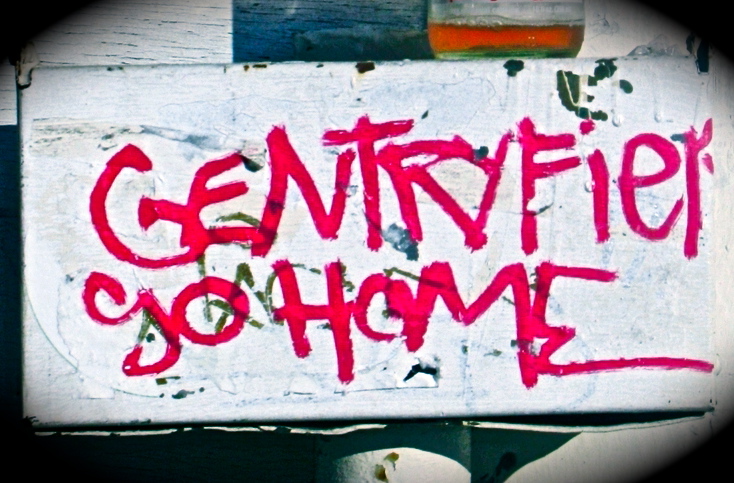
Give Us Back The City

Almost two years have passed since I first began writing and documenting the surge in Portland’s creeping gentrification and what the monoculture means for the rest of us. I barely recognize the city anymore. In my last article on gentrification I talked about the gay street I used to hang out on when I first moved here and how different it is. I could write an essay on every neighborhood here with similar content.


Our mainstream media has finally caught up and started writing about gentrification and the current housing crisis. It’s not without drama however, the latest being a Willamette Weekly contributor writing an arrogant op-ed about his apartment complex the Burnside 26 which created a lot of controversy with it’s promo video showing a very White Upper Middle Class heterosexual couple enjoying a leisurely lifestyle. It made a lot of people angry.

Some bullet points about the current issues at hand include us having the lowest vacancy rate in the country (12%), a recent exposé that provided documents showing City Hall officials had hidden high-rise development projects from the public, news that Google will be opening an office downtown and a recent report that Portland is the most gentrified city of the city.

So where does that leave the rest of us?

I’m terrified of being priced out; the signs are already there. The cost of food and transportation continues to rise as rents inflate. Looking at the housing market, homes that cost 300,000 in 2007 are now double that.

The city has changed so much. Along with the prices, the culture has changed. The people have changed. I don’t feel welcome in a city that was a sanctuary for me in my younger years. I am afraid I won’t be able to stay here in the long term.


Gentrification is breaking my heart.
I don’t have answers, I don’t have a solution.
I only have my slow boiling rage.

I’ve engaged in a lot of dialogue recently about gentrification, especially about those who are contributing to it such as tech companies and white collar suburbanites who are flocking to cities like Seattle, San Francisco and Portland. I’m done being civil about it.

So I’m going to be frank.

This is a culture war. It’s a war for the soul of the city. Somewhere along the line Portland got popular and was put on the cultural map. What was weird is now gone and replaced by this monolith of White middle-class monoculture. So I say this to you, the gentrifiers: You are pushing us out! If you want to live in a family-friendly neighborhood, go live in the suburbs!
GO AWAY. Stay out of our communities! We didn’t build this for you.


As Seattle artist John Criscitello said:

“WE CAME HERE TO GET AWAY FROM YOU.”


2015-03-27

Life Under Portlandia


I’ve struggled over the last few weeks with what to write in this essay, it’s really been haunting me. I feel embattled by culture and by my own feelings. I moved here when I was still a teenager. Portland was exciting, new and even a bit gritty. Things here were more rockabilly and less twee. I suppose it must have been before the era of the IPA and brunch. To me it is not a surprise that a recent national study found that Portland was the most gentrified city of the century.


During my first three years I saw our rent increase twice, which was not ideal but it hadn’t priced me out of the neighborhood. As time wore one though, I witnessed the distinct character of the Portland that I was enthralled by as a teenager and young adult change. I would say that the change has been more drastic than gradual.

In college I learned what gentrification is and I also learned about the historical (and perhaps continued) redlining of certain districts in Portland that systemically disenfranchised the Black community. I would point out the Mississippi, Alberta, Albina, and Irvington neighborhoods as specific and ongoing examples of this gentrification.


What is (perhaps to some) not surprising is that this is now happening to other neighborhoods all around the city, mostly in Southeast but also much of the Downtown area is becoming gentrified. I think gentrification is still a dirty word in Portland, I swear it’s a conversation to clear a room or get looked at like you dropped a couple of f-bombs.

However it seems like now people care about it a little more now (see the somewhat offensive “Le Tour de Gentrification” of last summer) and some recent articles in local and regional papers. Perhaps this is because it’s not just happening to the POC neighborhoods. Portland seems to be full of perennial White guilt and avoidance of race-based discussion. But then, we have “Oh no, not our food carts”.

Anyway, gentrification is happening all over the city to some extent as the city government tries to attract new companies and higher-earning citizens to come invest in Portland. Two examples of neighborhoods being gentrified that are personal to me are the Stark street area downtown and Division Street in Southeast.

The stretch of Stark Street from what is now a McMenamin’s Crystal Palace to Living Room Theatres was the gay street. It was colloquially known as Vaseline Alley or the Pink Triangle. It is still home to the Roxy but also hosted five gay establishments including the bathhouse that the McMenamin’s corporation turned into a hotel/restaurant.  There was also a wonderful goth night at the Fez Ballroom which is also now closed. The last gay bar on the street is Scandals, and there are rumors that it too will be closing its doors soon.

As a queer person, I used to hang out on this street. It felt like home. Sure it was a bit wild and sometimes nasty, but it was familiar and safe. Now I don’t recognize the street of pavement covered in bougie hipster coffee shops, eateries (one of which whose owner has some questionable ethics) and the Ace Hotel. These new places, they’re not built for my communities. They serve the influx of new residents who move from places where these kinds of businesses are an expected norm.

Now to Division Street, which is a growing example of this norm. This stretch of asphalt had been, for a long time, gritty and exciting but not so suburban. I remember walking its lengths many times, past the porn theatre and various dive bars. One of my favorite cafés was on Division. At this point the clientele has changed so much that I do not feel comfortable or welcome in there anymore.


Along with the demographic changes of the neighborhood, developers have lined lower Division with condominium complexes, all with the same boxy style to where it’s difficult to see where one ends and one begins. Parking has become an issue for residents as tourists and others flock to the neighborhood to stand in line for hours at the new Salt & Straw or browse the many pop-up boutiques.

The neighborhood is becoming unaffordable to long-time residents and the new businesses and living quarters that are being built are a harbinger of this.  The rents are ridiculous. Just take a look at the prices of meals at the new restaurants, look at the clothes people are selling or the cars lining the side streets. It’s not a working-class or artistic community area anymore.

Two things happened recently that really galvanized my desire to write this essay. I had a conversation with a colleague of mine who was from Portland. We both used to hang out at the same spots downtown when we were younger.

Talking with her got us both nostalgic and we discussed how all the places we used to frequent were either closed or were now so different that we didn’t recognize them anymore. Some of our old haunts and activities included going to the two underage clubs, smoking cigarettes in the back room of Anna Banana’s, staying up ‘til 2am at Portland Coffee House on Broadway and Alder, dancing to salsa and bachata at Andreas over on Belmont. Sadly, these are all fantasy of distant memory now. A sports pub has replaced Andreas, and Portland Coffee House is now called Public Domain, closing around 9pm and definitively no longer welcome to the previous community of assorted freaks, students, street kids and artistic types.


It is this culture shift that I see in the Red & Black Café closing, the other recent event that has contributed to this essay. While the owners of the café did not specify why they are closing up shop, they did say that business took a nosedive once the New Seasons market and Starbucks opened for business on the street.

The Red & Black café has served many of our alternative communities in Portland for a long time. I know them as a safe space away from bigotry and police violence as well as functioning as type of community center for like-minded citizens. I think what scares me the most about their closing is that to me, it signals a visible shift in the politics of the city.  I perceive Portland as becoming more conservative, a neoliberal kind of conservative to be sure but we’re definitely not as radical as we used to be.

It is because of this shift in both demographics and politics that I fear for the soul and character of this city. Many of us have lived here for so long and are invested in the long-term health of our communities here, but when things change so drastically and it becomes unwelcoming to us, especially for those of us who are minorities, where are we supposed to go? Seattle, Oakland, Austin and other similar areas aren’t much different.

This is why gentrification matters to me, and why I won’t stop criticizing the Portland city commission, the business commission or the mayor’s office. It’s why I involve myself in writing, organizing and trying to fight bad policy that affects our communities. I live here; this town raised me and taught me so much.  

Gentrifiers beware: We want our city back!


2012-12-14

Classism & Shoplifting Accusations: Why Intersectionality Matters

I went to a popular/famous bookstore here in Portland yesterday to find some thank-you cards and a gift for my friend. The device to enter my debit card password was acting up and the cashier treated me like it was my fault.

This reminded me of the time I was accused of stealing by one of their managers...I had been reading in the café there for my anthropology class and when I left, the security system went off. The security guard stopped me and the manager went all passively apeshit as they are wont to do here. She was very condescending and the security guard kept trying coerce me into admitting that I knew him. I was adamant in my refusal and denial. The item in question was a  book that I had bought at my college bookstore. It even had the sticker from that store still on it and was filled with my reading notes! It wasn't my fault that they couldn't find their only copy. It was humiliating.

I am aware that I am very White-passing, so I do not think that race was playing a factor. I do think that class was. When I was in college I dressed gothy or grungy (because it was cheap) and favored hoodies. I also had prominent piercings. I don't wear expensive looking clothes. I dress differently at work, but when I'm on my own time I dress how I please. What I notice is that people definitely treat me differently depending on the context and the clothing I'm wearing at the time. You never see well-dressed people being accused of stealing. This is why intersectionality matters. We have to be aware of all these things and how they work together.

Needless to say, I don't shop at that bookstore very often now.

2012-05-04

Driving Miss Gaga


"Are Latinos supposed to be grateful that a white superstar, born of privilege, included a racist shout out to our community? Not all Latino ladies are 'cholas' in the barrio, some of them are teachers, writers, engineers and nurses and doctors." -- Robert Paul Reyes

A while back I wrote an article praising the Estonian technopop artist Kerli Kõiv because she represents what I think a true musician should be: modest, compassionate and real. For juxtaposition I am going to talk about Stefani Germanotta better known as Lady Gaga.

I have remained silent for the most part in my dislike of Lady Gaga. I am not a fan of attention-seeking stunts or high fashionistas. I am especially not into mainstream American pop music and Lady Gaga is arguably mainstream.

My real beef with her though, is her privilege. She is from a wealthy background (she used to party with Paris Hilton), she is conventionally attractive, and she is cisgendered, White and skinny. Her inability to accept any of this is troubling.

Somehow there was some kind of rumor that Lady Gaga came from a poor background and that she made herself from nothing, this is patently untrue. In her wikipedia article she is quoted as having said that her family came from modest means and that her parents worked for everything. Her private school upbringing and matriculation to the exclusive Tisch School of the Arts at NYU say otherwise. I have heard the argument before, about parents working hard. My parents worked hard, my dad put himself through medical school on scholarships and crappy cleric positions, but that doesn't mean my sister and I grew up with little means. I have no problem accepting and deconstructing my class privilege.

Another issue with Gaga's privilege is her racism. People hailed her single "Born This Way" as the newest "gay anthem". Hold up, what? I gotta wonder, have these people even read the lyrics: "YOU'RE BLACK, WHITE, BEIGE, CHOLA DESCENT
YOU'RE LEBANESE, YOU'RE ORIENT".

Excuse me, but that is racist. It is tacitly agreed that using the word "Oriental" is about the same as using the word "Negro" and wholly inappropriate. Political correct-ness aside, this was a stupid word to use in a song dubbed progressive. Orientals are rugs, not people. (Ed. I understand that she didn't use the word "Oriental" precisely but she did truncate the word to fit her rhyme, she refers to races in this line so arguably the word "orient" was referring to "Oriental" or Asian. So STFU.)

Furthermore, the word "chola" is problematic too. The term was originally used as a designation for people of mixed or pure Amerindian descent in the racist classification system of colonial Latin America. The word presently has come to refer to "low income Mexican-American families in the United States" or "Latino gangsters". (see Wikipedia article here). Miguel Perez, of Chicanos Unidos further elucidates in this article. Basically, Gaga is relegating all Latinos to this designation of poor and criminal.

Also, what is this beige bullshit? I guess that's my category.

I just want people to see Lady Gaga for who she is. She is not "weird" or unattractive, that is her makeup and clothing. She is skinny, she is White and she dresses as our society prescribes for her biological gender. What is special about 
that?

It's easy to be angry with all of this, but in the end it's like my boyfriend said this morning,“When we're talking about Lady Gaga and Madonna, we’re not talking about women; we’re talking about clothes and makeup.”

(Ed. note: Also, see Lady Gaga's "Little Monster" fans respond to Miguel Perez's article Warning! Very triggering.)